
Home canning has made a genuine comeback in recent years, and for good reason. Preserving your own food gives you full control over ingredients, cuts down on waste, and builds a pantry that can last through an entire season. But the equipment matters enormously, especially when canning low-acid foods like vegetables, meats, and beans that require pressure processing rather than a simple water bath.
Choosing the right pressure canner for sale is one of the most important decisions a beginner will make, and getting it wrong is not just inconvenient. It is a safety issue. This guide walks through everything that matters before making that purchase.
Why Pressure Canning Is Different From Water Bath Canning
New canners often assume all canning methods work the same way. They do not. Water bath canning works for high-acid foods like jams, pickles, and tomatoes because the acid creates an environment where harmful bacteria cannot survive at boiling temperatures. Low-acid foods are a different situation entirely.
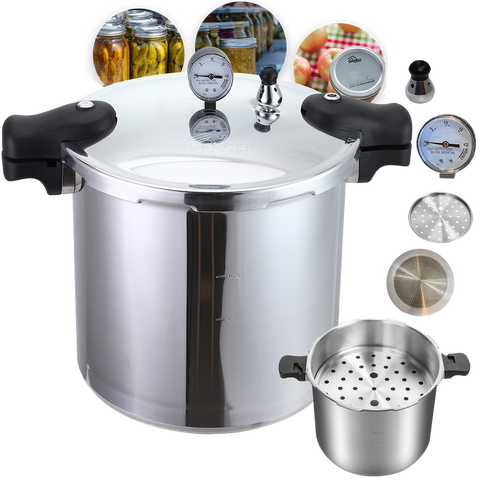
Vegetables, meats, poultry, fish, and mixed soups must reach a temperature of 240 degrees Fahrenheit to destroy Clostridium botulinum spores, the bacteria responsible for botulism. Boiling water only reaches 212 degrees, which is not enough. A canning pressure canner uses steam pressure to push temperatures above that threshold, which is why it is the only safe method for processing low-acid foods at home. There is no workaround for this, and no shortcut that produces a safe result.
What to Look for When Shopping for a Pressure Canner
Not every canner on the market is built the same way, and the differences matter for both safety and usability. Here are the factors worth paying close attention to before purchasing.
Pressure gauge type. Pressure canners come with either a dial gauge or a weighted gauge. Dial gauges give a specific numeric readout and need to be tested annually for accuracy. Weighted gauges use a regulator that rocks or jiggles at the correct pressure, which is simpler for beginners and does not require calibration. Both work well when used correctly.
Capacity, Canner size is measured by quart capacity and determines how many jars can be processed in a single batch. A beginner processing small harvests may not need the largest option available, but anyone canning regularly for a family or putting up large quantities of garden produce will find a large pressure canner significantly more efficient over time. Processing fewer batches saves both time and energy cost.
Material and build quality. Heavy-gauge aluminum and stainless steel are the standard materials for quality canners. Thin walls distribute heat unevenly and can warp over time. A well-built canner handles repeated use across many canning seasons without losing its seal performance.
Safety features. Look for an over-pressure plug or safety valve that releases if pressure builds beyond safe levels. A locking lid mechanism that prevents the canner from being opened under pressure is essential. These are not optional features on a serious canning pressure canner.
Denali Canning carries options that address all of these requirements, including models suited to beginners starting with smaller batches and those ready to invest in a large pressure canner from the start.

Matching Canner Size to Your Canning Goals
One of the most common mistakes beginners make is buying a canner that is either too small for their actual output or too large for their stovetop setup. The right size depends on a few straightforward factors.
For someone canning for one or two people with a standard home garden, a smaller canner handles the workload without taking up unnecessary storage space. For a household preserving large harvests, processing meat in bulk, or putting up full cases of jars at a time, a large pressure canner becomes the more practical and economical choice. Running four batches instead of two to process the same quantity of food adds hours to the canning day.
Stovetop compatibility also matters. Large canners with a wide base require a burner that can evenly heat that surface. Glass and ceramic cooktops have weight restrictions that can rule out the heaviest canner options. Confirming stovetop compatibility before purchase prevents a costly mismatch.
Pressure Canner Size Comparison Chart
|
Canner Size |
Jar Capacity Quart jars / Pints |
Best For Household size |
Stovetop Note Compatibility tip |
|---|---|---|---|
|
Small 10 - 12 Quart |
4 Qt • 8 - 9 Pints | 1 - 2 people | ✓ Glass & ceramic safe |
|
Medium 16 - 22 Quart |
7 Qt • 16 Pints | Family of 3 - 4 | ⚠ Check glass top limits |
|
Large 23 - 30 Quart |
7 Qt • 18 - 20 Pints | Large family / harvest | ✗ Gas or coil burner only |
|
Extra Large 30+ Quart |
14 Qt • 32+ Pints | Bulk / homestead | ✗ Outdoor propane burner |
Free Shipping Available on Qualifying Orders at Denali Canning
Canning pressure canners • Replacement parts • Jar sets • Canning accessories
Beginner Safety Rules That Most Guides Leave Out
The mechanics of a pressure canner are not complicated, but new canners sometimes skip steps that experienced preservers follow automatically. These are worth stating clearly.
Never overfill a pressure canner with water. Most canners require two to three inches of water at the bottom. Too much water interferes with pressure buildup, and too little risks the canner running dry mid-process.
Always vent steam before pressurizing. After the lid is locked and heat is applied, steam needs to exhaust freely for ten minutes before the weighted gauge is placed or the petcock is closed. Skipping this step traps air inside and produces inaccurate pressure readings.
Let pressure drop naturally. Never run the canner under cold water to speed up pressure release. Forced cooling can break jar seals, cause liquid loss from the jars, and in some cases warp the canner itself.
Check the gasket before every use. A cracked or hardened gasket will not seal properly, which means pressure will not build correctly. Gasket replacement parts are inexpensive and worth keeping on hand.
Denali Canning includes use and care guidance with its equipment specifically because these beginner gaps are where most canning problems originate. When the equipment is quality and the process is followed correctly, pressure canning is both safe and straightforward.
Conclusion
Choosing a pressure canner for sale is not a decision worth rushing. The right canner matches the cook's output, stovetop setup, and comfort level with the equipment. Whether the goal is a starter canner for weekend batches or a large pressure canner built for a full harvest season, understanding what matters before buying saves time, money, and frustration. A pressure canner sale is only a good deal when the canner is the right fit for the job it will actually do.



Comments (0)
There are no comments for this article. Be the first one to leave a message!