Pressure canners are not gentle on a stovetop. They are heavy even before the jars go in, they need steady heat for a long stretch, and a glass or induction range can complicate that in ways a gas burner never does. Buy the wrong pairing and you end up with a canner that never quite reaches pressure, or a stovetop that was never rated to hold it in the first place. New buyers ask about stovetop compatibility more than almost anything else, right after price and jar capacity. Here is what actually determines whether pressure canners work on a given stove, and where a canner like the TANKER fits into that picture.
What Actually Determines Whether Pressure Canners Work on a Stove?
It comes down to two things every time: whether the canner's base makes full, flat contact with the burner, and whether that burner can produce and hold enough heat for the entire processing time, not just get the pot up to pressure once.
Flat, Heavy-Bottom Contact Is Non-Negotiable
The base needs to sit fully flat against the burner, with no rocking and no gap at the edges. On many stoves, manufacturers ask that the pot's base not extend more than about an inch past the burner in any direction, since an overhanging base heats unevenly and puts extra stress on the cooktop underneath it. The TANKER is built with a flat, heavy base for exactly this reason, since a warped or dished bottom will struggle on any stovetop, glass or otherwise. A canner that has been dropped or stored badly can develop a slight dish in the base over the years, and that alone is enough to keep a stovetop from heating it evenly, whatever the surface.
Why Some Burners Can't Keep Up
Getting a canner up to pressure is only half the job. It then has to hold that pressure steady for the full processing time, which can run past 90 minutes for larger cuts of meat or a full load of low-acid vegetables.
Sustained Heat, Not Just High Heat
Some smooth-top electric elements cycle on and off to hold a set surface temperature rather than running continuously, which can make it harder to keep pressure steady across a long processing window. Gas burners and traditional coil electric elements generally run continuous heat instead, so they tend to hold pressure with less fuss.
Looking for a Pressure Canner Built for Versatility?
Explore the TANKER and review the canner details before matching it to your stovetop setup.
Explore the TANKERDoes a Pressure Canner Work on a Glass Top Stove?
The honest answer for a glass top stove is that it depends on the stove's own rating, not just the canner sitting on top of it.
The Real Risk Is the Cooktop's Rating, Not the Recipe
Many glass and ceramic-top ranges list a maximum cookware weight in their owner's manual, and a full pressure canner loaded with jars and water can climb well past what the canner weighs empty. Dragging a heavy, full canner across the glass instead of lifting it into place is a common source of scratching, and some manufacturers advise against canning on their glass tops altogether. Before running a full load on a glass top stove, it is worth five minutes to check your specific model's weight limit rather than assuming it will be fine. If the printed manual is long gone, most stove manufacturers publish the same weight guidance on their support site, so it is worth the search before it is worth the risk.
Where the TANKER Fits on a Glass Top
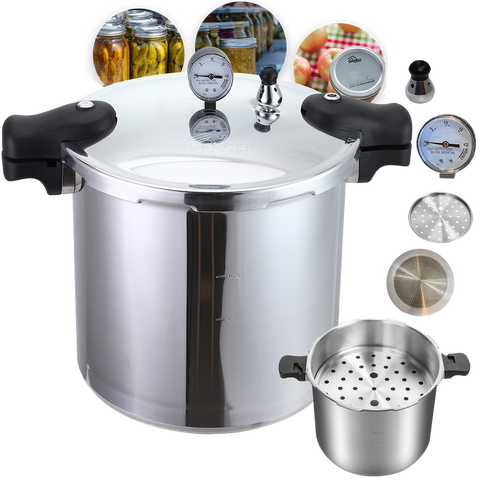
A canner's own build only covers half of that equation. The TANKER's base is flat and induction-compatible, and the canner itself is built to run across gas, electric, and induction ranges. That still leaves the stove's own weight rating as the other half of the decision, so anyone working with an older or lighter-duty glass top should confirm that number before loading a full batch onto it.
Build Out Your Pressure Canning Setup
These Denali options connect naturally with the equipment discussed in this guide.
Explore the pressure canner discussed throughout this article.
View the TANKERKeep another rack ready when you're working through multiple loads.
View Extra RackAdd extra coverage for your TANKER pressure canner.
View Extended WarrantyWhat About Induction and Electric Coil Stoves?
Induction Needs a Magnetic Base, Not Just Contact
Induction elements heat the pot itself through a magnetic field instead of heating the glass surface directly, which means only cookware with a magnetic base will heat at all. A canner with a plain aluminum bottom does nothing on an induction burner no matter how long it sits there, which catches a lot of first-time buyers off guard. There is an easy way to check any pot before buying one: hold a refrigerator magnet to the bottom. If it grabs on, the pot will heat on induction; if it just sits there, it will not, no matter what the stove's power setting says. A canner built with an induction-compatible base responds directly, so that test is not something you need to run at checkout.
Electric Coil Is the Simplest Case
Traditional coil electric burners heat the way gas does in one important sense: the pot sits directly on a solid, continuously heated element instead of a glass surface. A pressure canner behaves the same way on coil electric as it does on gas, with no magnetic requirement and no weight-rating research needed beyond ordinary common sense. It is one reason plenty of longtime canners keep an old coil range around even after upgrading the rest of the kitchen.
Compare Denali Canning Appliances
Browse pressure canners and cooking appliances before choosing the setup that fits your kitchen.
Browse Canners & AppliancesGetting a Full Load of Jars to Pressure, Whatever the Stove
Signs a Burner Is Underpowered for the Job
If a full canner takes an unusually long time to reach pressure, or the pressure weight will not hold a steady rock even with the burner on high, the burner itself is often the reason rather than anything wrong with the canner. This shows up most often on glass-top elements that throttle back once they reach a set surface temperature, even with the canner sitting correctly and the vent clear. It is easy to blame the canner at that moment, but swapping stoves rather than swapping canners is usually what actually fixes it.
When an Outdoor Burner Is the Better Call
For very large batches, an older glass top range, or a kitchen that already runs warm during canning season, a dedicated outdoor propane burner sidesteps the whole question. It is built to hold high, continuous heat regardless of what an indoor stove can manage. Running two or three loads back to back also goes faster with a spare canning rack ready to load while the first batch is still processing outside.
Use only heat sources specifically permitted by your pressure canner manufacturer. High-output outdoor or turkey-fryer-style burners may exceed a canner manufacturer's heat limits. Always follow the canner manual, use a current tested pressure-canning recipe, make the required altitude adjustment, and follow the specified venting and pressure procedure.
Stock the Rest of Your Canning Kitchen
Find racks, lids, accessories, and other supplies for your next preserving day.
Shop Canning SuppliesNone of this has to be complicated before your next canning weekend. Once you know your stove's weight rating and whether it holds steady heat, the canner itself is the easy part. Denali Canning builds the TANKER to run across gas, electric, and induction, backs it with an extended warranty for anyone who wants extra peace of mind, and stocks the rest of what a canning kitchen needs besides. Check your stove's manual, load the rack, and get back to canning.
Want More Practical Canning Guides?
Explore Denali Canning's educational articles for more help with pressure canning, supplies, maintenance, and food preservation.
Read Canning GuidesFAQs
1. Can I pressure the can on a glass top stove?
It depends on your stove's own weight rating, not just the canner. Many glass and ceramic-top ranges list a maximum cookware weight, and a full pressure canner loaded with jars and water can get close to or past that limit. Check your stove's manual before running a full load, and keep the canner's base within about an inch of the burner's edge on every side.
2. Does a pressure canner work on an induction cooktop?
Only if the canner's base contains magnetic metal, since induction heats cookware through a magnetic field rather than heating the surface directly. A plain aluminum bottom will not heat at all on induction, no matter how long it sits there. Canners built with an induction-compatible base, like the TANKER, are made to respond correctly.
3. Will a full pressure canner crack or damage my glass stovetop?
It can, mainly from excess weight, an overhanging base, or dragging the pot across the surface while it is full. The safest approach is to confirm your stove's rated weight limit first and lift the canner into place rather than sliding it.
4. Can I use a pressure canner outdoors on a propane burner?
Yes, and for very large batches or older glass top ranges, it is often the more reliable option. Outdoor burners are built to hold high, continuous heat, which sidesteps stove-specific weight limits and cycling elements entirely.
5. Does the type of stove change how long processing takes?
The processing time itself, once you are at pressure, stays the same regardless of stove type, since that number is set by the recipe and altitude, not the burner. What can change is how long it takes to reach pressure in the first place, which runs longer on a burner that cycles or puts out less sustained heat.
6. What should I do if my canner won't come up to pressure?
Check the burner's heat output before assuming something is wrong with the canner. A weak or cycling burner is a common culprit, along with a gasket or vent that needs cleaning. If a strong, steady burner still will not bring it to pressure, that is the point to check the canner itself.


Comments (0)
There are no comments for this article. Be the first one to leave a message!