
So you've decided it's time to start preserving your own food. Maybe you've got a garden overflowing with green beans, a chest freezer packed with venison, or you just want real food security without depending on the grocery store. Whatever your reason a canning pressure canner is about to become the most hardworking appliance in your kitchen.
Pressure canning can feel intimidating at first. The gauges, the steam, the jars it looks complicated. But here's the truth: once you understand the basics, it's one of the most straightforward and satisfying skills you'll ever learn. This complete guide walks you through everything from why pressure canning matters, to how it works, to what to look for when you're ready to buy.
Why Pressure Canning — And Why It Matters for Food Safety
Not all foods can be preserved using the same method. High-acid foods jams, jellies, pickles, tomatoes can be safely processed in a simple water bath canner because their natural acidity prevents harmful bacterial growth. But low-acid foods are a completely different story.
Meats, poultry, fish, beans, corn, carrots, potatoes, soups, and stews all fall into the low-acid category. These foods require temperatures well above the boiling point of water to safely destroy Clostridium botulinum the bacteria responsible for botulism. A standard water bath canner only reaches 212°F, which is simply not enough. A canning pressure canner reaches 240°F and above under pressure, making it the only method the USDA recommends for safely preserving low-acid foods at home.
"Pressure canning isn't just about convenience it's about doing things right. The temperature matters. The pressure matters. The equipment matters. Get those three things right, and home canning is one of the safest food preservation methods available."
This is why investing in a quality canner not just any pot with a lid is so important. The difference between a proper canning pressure canner and an underpowered or poorly designed alternative isn't just performance. It's safety.
How a Pressure Canner Actually Works
Understanding the basic mechanics helps you use your canner with confidence. Here's what's happening inside that sealed pot:
A small amount of water in the bottom of the canner heats up and produces steam. As the lid is sealed, steam builds pressure inside the vessel.
Under pressure, the boiling point of water rises significantly above 212°F reaching 240°F at 10 PSI. This higher temperature penetrates jars and destroys harmful bacteria.
Your recipe specifies the pressure (usually 10–15 PSI) and processing time. Maintaining consistent pressure throughout this period is what ensures food safety.
After processing, the canner depressurizes on its own. As jars cool, a vacuum seal forms that satisfying "pop" you'll hear is the lid sealing safely.
Dial Gauge vs. Weighted Gauge: Which Should You Choose?
When shopping for a canning pressure canner, one of the first decisions you'll encounter is the pressure monitoring system. Each has distinct advantages:
Displays exact PSI on a numbered face. Great for precision — but requires annual calibration testing to ensure accuracy. Best for experienced canners who like to monitor closely.
Uses a rocking weight to automatically regulate pressure. Simpler, self-regulating, and requires no testing. Ideal for beginners who want reliability without guesswork.
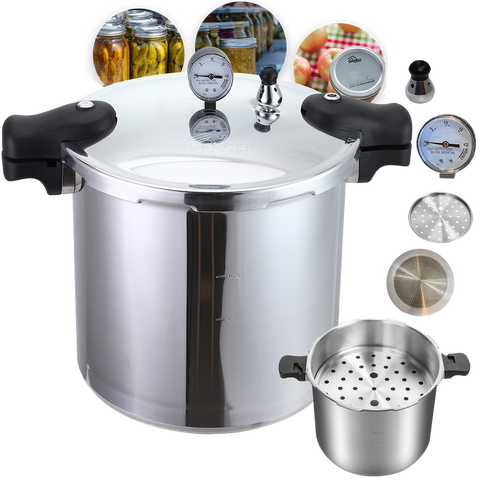
The best canners include both systems giving you the precision of a dial gauge alongside the reliability of a weighted regulator. This dual approach is especially valuable for beginners who want confidence in their pressure every single batch.
Size Matters: The Case for a Large Pressure Canner
Choosing the right size canner is a decision worth getting right the first time. Many beginners start with a smaller model and quickly find themselves wishing they'd gone bigger. Here's why size genuinely matters:
- More jars per batch — A large pressure canner (23 quarts or more) can process 7 quart jars or a full rack of pints in a single run cutting your time at the stove significantly
- Better for bulk preserving — If you buy in bulk, grow your own food, or hunt and fish, a larger capacity means you can preserve an entire harvest without running multiple batches
- More energy efficient over time — Fewer batches means less time heating up and cooling down, which adds up to real savings on your energy bill over a full canning season
- Handles tall quart jars comfortably — Smaller canners sometimes struggle with taller jars; a large pressure canner accommodates standard quart and half-gallon jars without issue
- Future-proofs your setup — Your canning ambitions will grow. A larger canner grows with you rather than limiting you within a season or two
If you're on the fence between a 16-quart and a 23-quart model go with the 23. Nearly every experienced home canner will tell you the same thing: they wish they'd started bigger. The cost difference is minimal compared to the time and frustration you save over years of canning.
Pressure Canner Size Comparison at a Glance
| Capacity | Quart Jars (Single Layer) | Pint Jars | Best For |
|---|---|---|---|
| 10–12 Quart | 4 jars | 7–8 jars | Single person, occasional use |
| 16 Quart | 7 jars | 10 jars | Small families, moderate use |
| 23 Quart | 7 jars (double layer) | 16–18 jars | Families, bulk preserving, homesteaders |
| 30+ Quart | 14+ jars | 24+ jars | Large families, market gardeners |
What to Look for When Buying a Pressure Canner
Not every canner on the market is built to the same standard. When you're ready to invest and it is an investment worth making look for these features:
- Heavy-gauge aluminum or stainless steel construction — Thinner walls heat unevenly and warp over time; look for a thick, sturdy base
- Universal stovetop compatibility — Confirm it works on your stove type: gas, electric, glass-top, and induction all have different requirements
- Multiple safety vents — At least a primary and overpressure vent for safe steam release if pressure exceeds safe limits
- Locking lid system — A canner should not be openable under pressure; proper locking mechanisms are non-negotiable
- Both gauge types — Dual dial and weighted gauge systems give you precision and reliability in every batch
- Included canning rack — Jars should never sit directly on the bottom of the canner; a rack ensures even heat distribution and protects jars
Ready to Find Your Perfect Canner?
Denali Canning builds pressure canners specifically for serious home preservers — with dual gauge systems, universal stovetop compatibility, and heavy-duty construction designed to last decades. Whether you're looking for your first canner or searching for a pressure canner sale to upgrade your setup, explore our full lineup and find the right fit for your kitchen.
Shop Pressure Canners →What Can You Actually Preserve With a Pressure Canner?
Once you have your canner, the possibilities open up dramatically. Here's a taste of what becomes available to you:
- Vegetables — Green beans, corn, carrots, beets, potatoes, peas, asparagus
- Meats & poultry — Chicken, beef, pork, venison, ground meat, bone broth
- Fish & seafood — Tuna, salmon, clams, shrimp
- Soups & stews — Ready-to-heat meals, chilis, bean soups, vegetable broths
- Beans & legumes — Dried beans pre-cooked and canned for instant pantry use
- Sauces & stocks — Tomato-meat sauces, chicken stock, beef bone broth
This is what transforms pressure canning from a hobby into a genuine lifestyle shift. A well-stocked pantry of home-canned food means real food security, dramatically lower grocery bills, and the deep satisfaction of knowing exactly where your food came from and what's in it.
The Right Canner Changes Everything
Whether you're brand new to food preservation or you've been water bath canning for years and are ready to go further, a quality canning pressure canner unlocks a level of home food production that simply isn't possible any other way. The learning curve is short. The rewards are enormous. And the right equipment makes all the difference.
Don't let size intimidate you. Don't let the gauges confuse you. Start with a large pressure canner that will grow with your ambitions, understand what you're looking for in terms of safety and quality, and give yourself permission to learn one batch at a time. Before long, you'll be the one people are turning to for advice and your pantry shelves will speak for themselves.
If you're currently watching for a pressure canner sale to make your first purchase, make sure you're comparing models by capacity, gauge type, stovetop compatibility, and safety features not just price. The right canner at the right price is worth waiting for. But a cheap canner that doesn't perform safely or efficiently isn't a deal it's a frustration waiting to happen.



Comments (0)
There are no comments for this article. Be the first one to leave a message!