
Canning Tips April 2026 · 7 min read
You ran a full processing cycle. You waited through the cooldown. You pressed the center of the lid and it popped right back up. Seal failure. Batch lost. Most canners immediately blame their equipment, but here is what nobody tells you early enough: the pressure canner is rarely the problem. Your canning lids and rings are the deciding factor in whether a batch succeeds or fails, and they get far less attention than they deserve. These five things will change how you think about every batch from here on out.
"Your canner creates the environment. Your lids create the seal. Get the lids wrong and nothing else matters."
1. Your Lid Is a Single-Use Tool, Not a Reusable One
The flat lid that sits on your mason jar contains a sealing compound on the underside, a soft layer of material that compresses under heat during processing to form an airtight bond with the jar rim. That compression happens exactly once. After a lid has been through a full canning cycle, the compound has already conformed to that specific jar and will not create a reliable seal a second time around.
This is one of the most common causes of seal failures that canners cannot explain. The lid looks fine. It sits flat. It shows no visible damage. But the compound underneath is spent, and no amount of heat or pressure changes that. Always start every batch with fresh, unused lids. Your rings are the opposite story. Made from premium forged steel, they are fully reusable. Their role is purely mechanical, holding the lid against the jar rim while the seal forms underneath. As long as a ring shows no rust or warping, it goes right back into rotation without any issue.
2. Tightening Your Ring Too Hard Is Quietly Hurting Your Seal
Most beginners assume that screwing the ring down as tightly as possible gives the lid the best chance of sealing. It actually does the opposite. When you over-tighten the ring before processing, you prevent air from venting out of the jar as it heats up inside the canner. That trapped air interferes with the vacuum formation, and the result is a partial seal or no seal at all despite a perfectly normal-looking lid when you pull the jar out.
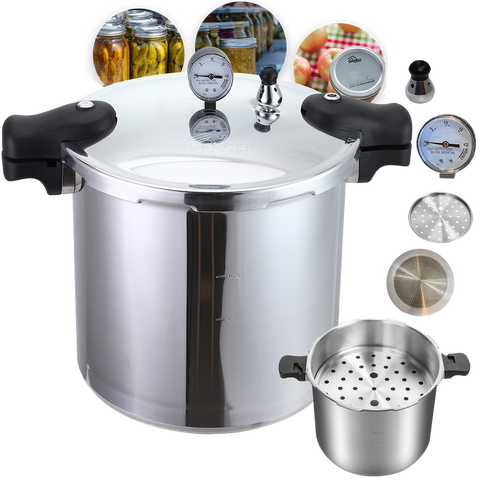
The correct approach is fingertip tight. Grip the ring with your fingertips, not your whole hand, and tighten just until you feel resistance. That is enough to keep the lid in contact with the jar rim while still allowing air to escape during processing. It is a small adjustment that takes about two seconds per jar and makes a measurable difference across an entire batch, especially when you are running a full 23-quart load of 7-quart or 20-pint jars at once.
3. Not Every Lid Is Built for What a Pressure Canner Demands
There is a genuine difference between a lid designed for water bath canning and one built to hold up under the sustained heat and pressure of a pressure canner. Water bath processing works at boiling point. Pressure canning goes significantly higher, and not every lid on the market is engineered to stay flat and maintain contact with the jar rim throughout that entire cycle without buckling.
When a lid buckles mid-process, it lifts away from the jar rim before the sealing compound has had the chance to bond properly. The jar comes out looking normal. The lid sits flush. You will not know anything went wrong until you check the seal hours later or, worse, until you open a jar on the shelf weeks down the line. Buckle resistance is not a marketing phrase. It is the specific construction quality that determines whether your lids hold their shape when it matters most. Always confirm the lids you use are built for pressure canning, not just water bath work.
4. Regular Mouth and Wide Mouth Are Not Interchangeable and the Difference Is Bigger Than You Think
This is the section most canning blogs skip over because it sounds too simple to be worth explaining. It is not simple and it is absolutely worth explaining, because this mistake shows up constantly and it costs people entire batches.
Regular mouth jars have an opening that measures approximately 2.75 inches across. Wide mouth jars measure approximately 3.38 inches. The lids and rings for each are sized specifically to that measurement and they are not interchangeable. A regular mouth lid placed on a wide mouth jar sits inside the rim instead of resting on top of it. A wide mouth lid placed on a regular mouth jar hangs over the edge. Neither creates a proper seal surface, no matter how carefully you process them or how good your equipment is.
Quick check before every batch: Look at the bottom of your mason jars. Most are marked either Regular or Wide Mouth directly on the glass. Sort your jars by mouth size before you start filling, not after. Discovering a mismatch when a jar is already packed and ready to go means either repacking it or accepting that the batch is a gamble.
If you regularly run both jar sizes in the same session and want to understand exactly how mouth size affects seal performance from a construction standpoint, this is covered in depth here: canning lids & rings. Worth reading before your next mixed batch.
5. Where You Store Your Lids Matters as Much as Which Lids You Buy
You can buy the right lids, keep them in the original packaging, and still open a batch of failures if they have been sitting in the wrong environment. The sealing compound on the underside of every canning lid is sensitive to the conditions around it. Humidity causes it to swell unevenly. Extreme heat from a garage or car trunk softens it to the point where it loses its ability to compress correctly under processing heat. Cold fluctuations cause it to stiffen and crack at the edges.
Denali lids carry a seal expectancy of up to 24 months, but that expectancy assumes proper storage in a cool, dry location away from direct light and temperature swings. A pantry shelf or a kitchen cabinet works well. A garage bin, a shed, or anywhere that gets hot in summer does not. Before every session, take thirty seconds to press your fingertip gently against the sealing compound on a few lids from the batch. It should feel smooth and slightly yielding. If any spot feels hard, gritty, or cracked at the edge, that lid does not go in the canner. The food you are preserving is worth more than the lid you are protecting it with.
Five Things. One Outcome. A Pantry You Can Rely On.
When a canning session fails it is tempting to blame the process. Most of the time the process is fine. The lids did the work they were asked to do, which was not enough because of something that happened before the canner ever came on. The right grip on the ring during packing. The age of the compound. The storage conditions over the winter. The mouth size of a jar sorted too quickly. These are the variables that experienced canners have already learned to control, and now you have them too.
Canning lids and rings are not the most exciting purchase in a canning setup, but they are the most consequential one. Everything else can be perfect and a bad lid still ends the batch. If you want lids that are rigorously tested, buckle resistant, and built to perform across both regular and wide mouth jars in packs sized for a full season, Denali Canning has everything you need. Your pantry shelf deserves jars that seal the first time. Stock up right here at Denali Canning and make sure your next batch is your best one yet.
Frequently Asked Questions
How long do Denali lids actually hold a seal?
Up to 24 months. That is the seal expectancy for Denali lids stored properly in a cool, dry location. For the best quality on what is inside the jar, plan to consume your preserves within that window.
Can I reuse my canning rings or do they need to be replaced too?
Rings can absolutely be reused. They are made from premium forged steel and their only job is mechanical, holding the lid in place during processing. As long as yours show no rust, bending, or corrosion, they are good to go again.
How thick are Denali lids compared to other brands?
Denali lids measure 2.1mm from bottom to top with a material thickness of 0.20mm. That puts them on par with the leading brands, and they are rigorously tested to perform just as well if not better when it comes to sealing.
How many jars can I run in one pressure canning session?
The TANKER 23-quart pressure canner holds approximately 7-quart jars, 20-pint jars, or 26 half-pint jars per batch. That is a serious amount of food in a single run, which is exactly why the quality of every lid in that load matters so much.
Does the TANKER work on my stovetop?
Yes. The TANKER is compatible with all stove types including gas, electric, and glass flat-top electric stoves, so whatever you are cooking on at home it will work right out of the box without any special setup.




Comments (0)
There are no comments for this article. Be the first one to leave a message!