
If you've ever stood in the canning aisle wondering what you actually need versus what's just clever packaging, you're not alone. The right canning supplies make the difference between a smooth afternoon of preserving and a sticky, frustrating mess with jars that don't seal. Whether you're canning your first batch of tomatoes or you've been doing this for years, having the right gear on hand saves time, money, and a fair amount of swearing in the kitchen.
What Actually Belongs in a Home Canning Setup
A lot of people overbuy when they start canning, grabbing every gadget in sight. You don't need most of it. At the core, you need jars, lids, rings, a canner (pressure or water bath, depending on what you're preserving), a jar lifter, and a wide-mouth funnel. That's genuinely 90% of what gets used in a typical canning season.
Lids are where people get tripped up. Reusable rings are fine to buy once and keep, but lids are single-use for a proper seal, so you'll go through a lot of them. Stocking up on canning lids and rings before peak season means you're not scrambling to find stock when every store shelf is picked clean in August. Buy more than you think you'll need. You will use them.

Do You Need a Pressure Canner, or Will a Water Bath Do?
This is the question that trips up almost every beginner. Water bath canning works for high-acid foods like jams, pickles, and most fruit. Low-acid foods, though, including green beans, meat, broths, and most vegetables, need a pressure canner to reach a temperature high enough to kill off bacteria that a water bath simply can't touch.
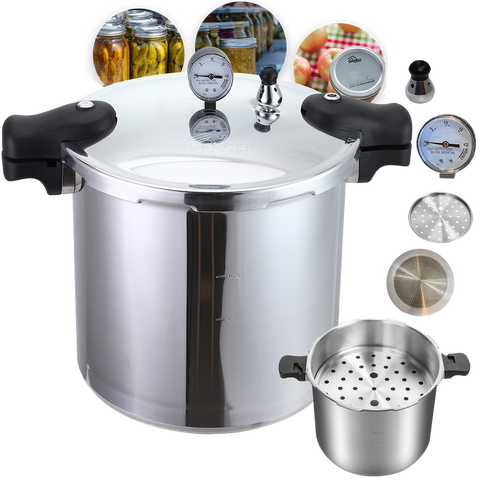
If you're planning to do anything beyond fruit and pickles, a pressure canner isn't optional. It's the piece of equipment that opens up your entire pantry to actual meals instead of just condiments. A solid option like the 23-quart pressure canner gives you enough capacity to process a full batch of jars at once, which matters a lot when you're working through a harvest that isn't going to wait around for a second round in the canner.
One thing worth knowing before you buy: pressure canners aren't interchangeable with pressure cookers. They're built differently, rated differently, and tested differently for safe processing. Don't try to substitute one for the other.
The Small Stuff That Saves You From Big Headaches
Once you have the big-ticket items sorted, it's the small tools that make canning day less painful. A magnetic lid lifter keeps you from fishing hot lids out of simmering water with your fingers. A bubble popper (a chopstick works in a pinch, but a real tool is nicer) removes trapped air pockets that can mess with your seal. A canning rack keeps jars off the bottom of the pot so they don't crack from direct heat contact.
Replacement parts matter too, and they're the thing most people forget until something breaks mid-season. Gaskets wear out. Pressure valves stick. Racks bend. Having a spare gasket or rack on hand means one worn-out part doesn't put your entire canning day on hold while you wait on a shipment.
Buying in Bundles vs. Piecing It Together
If you're starting from scratch, buying everything piece by piece adds up fast, and it's easy to miss something obvious, like realizing you have lids but no rings, or rings but not enough lids to match. A pre-assembled canning bundle usually works out cheaper than buying each item separately, and it takes the guesswork out of what quantities you actually need for a season.
This is one of the reasons Denali built its lid-and-ring bundles around actual usage patterns instead of arbitrary counts. A canner who's putting up a hundred jars of tomatoes needs a very different quantity than someone canning a few dozen jars of jam for gifts. Buying based on how much you're actually preserving, rather than grabbing whatever's on the shelf, saves you from either running out mid-season or ending up with a cabinet full of unused lids.
How to Tell Quality Canning Supplies From Cheap Knockoffs
Not all lids are created equal, and this is where a lot of home canners get burned. Thin, poorly sealed lids can fail to create a proper vacuum seal, which means spoiled food and wasted work after hours spent prepping and processing. Look for lids with a proper rubber compound around the edge, consistent thickness, and a seal that snaps down firmly once you hear that telltale pop.
If you're new to the process entirely, it's worth working through a pressure canning guide before your first batch. Canning has real food-safety stakes, and understanding processing times, altitude adjustments, and headspace requirements up front means fewer surprises and fewer batches that need to be redone.
Building Your Kit Without Overspending
You don't need to buy everything at once. Start with the essentials for whatever you're preserving first, whether that's a water bath setup for jam or a pressure canner for green beans and stock. Denali Canning's core lineup covers most of that starting point without pushing you toward tools you don't need yet. Add specialty tools as you find you actually need them rather than buying based on what looks useful in a product photo.
If you're expanding beyond canning into other preservation methods, tools like a dehydrator open up a whole different category of shelf-stable food without the processing times that canning requires. It's worth exploring once your canning setup is solid, especially if you're trying to preserve things like herbs, fruit leather, or jerky that don't do well in the first place.
Canning is one of those skills that gets easier every season you do it, and the right supplies are most of that equation. Once your kit is dialed in, the actual process stops feeling like a project and starts feeling like a normal Tuesday. Start with the basics, buy quality where it counts, and build from there - Denali Canning approach is to make that path obvious rather than overwhelming.
Frequently Asked Questions
1. What's the minimum canning supplies I need to get started?
Jars, lids, rings, a canner suited to what you're preserving, a jar lifter, and a wide-mouth funnel cover almost everything. You can add specialty tools later once you know what your specific canning routine actually calls for.
2. Can I reuse canning lids?
Standard canning lids are designed for one use because the sealing compound compresses during processing and won't reliably reseal a second time. Rings, on the other hand, can be reused indefinitely as long as they aren't rusted or bent.
3. How do I know if I need a pressure canner instead of a water bath canner?
It comes down to acidity. High-acid foods like jams and pickles are safe in a water bath, but low-acid foods like vegetables, meats, and broths need the higher temperatures a pressure canner reaches to eliminate harmful bacteria.
4. How often should I replace parts on my pressure canner?
Gaskets typically need replacing every one to three seasons depending on use, and pressure valves should be checked at the start of every canning season for wear or buildup. If a gasket looks cracked, dried out, or won't seal snugly, replace it before your next batch.
5. Is it cheaper to buy canning supplies in a bundle or individually?
Bundles are almost always cheaper per unit than buying lids, rings, and accessories separately, and they take the guesswork out of matching quantities. They're worth it if you already know roughly how much you preserve in a typical season.
6. What's the biggest mistake first-time canners make with supplies?
Underestimating how many lids they'll go through in a season is the most common one. The second is skipping a real canning guide and guessing at processing times, which can lead to unsafe seals or spoiled batches.



Comments (0)
There are no comments for this article. Be the first one to leave a message!