
If your kitchen counter disappears every August under mason jars, lids, and a pressure canner roughly the size of a filing cabinet, you already know the real challenge of home preservation isn't the canning itself. It's finding somewhere to put everything before and after.
Good canning supplies storage isn't about buying more shelving. It's about using the space you already have with a system that keeps jars within reach, lids sorted, and your canner out of the way until harvest season rolls around again.
Whether you're working with a galley kitchen, one narrow pantry closet, or a shared apartment with almost no counter room, a handful of smart adjustments can turn a chaotic cabinet into a setup that holds up canning season after canning season.
Sort Jars, Lids, and Rings Before You Store Them
Most canning supplies storage problems start before anything ever lands on a shelf.
Jars, rings, and lids all age differently and take up space differently, and treating them as a single category is how a small pantry gets overwhelmed fast.
Rings can handle a little jostling, so a deep drawer or a stacked bin works fine for them.
Lids are the fragile piece of the trio. They need to stay flat, dry, and unbent, which makes a slim upright organizer or labeled container a better choice than a loose pile.
Keeping a full set of canning lids and rings sorted by size means you're not digging through a mixed bin every time you start a batch.
Jars are the real space hog, so group them by size and keep only what you'll realistically use this season within easy reach.
Quick Canning Storage Reset
Browse Denali Canning Supplies
Find lids, rings, racks, and other canning essentials so you can restock the supplies you actually use instead of filling cabinets with mismatched extras.
Shop Canning Supplies →Give Your Pressure Canner a Permanent Spot
A pressure canner is the one item that breaks most small-kitchen storage plans, mainly because people try to treat it like a saucepan and tuck it into a cabinet where it barely fits.
Instead, give it one dedicated spot, ideally somewhere low and out of the main traffic path, since it's heavy and doesn't need to be reached often outside of canning season.
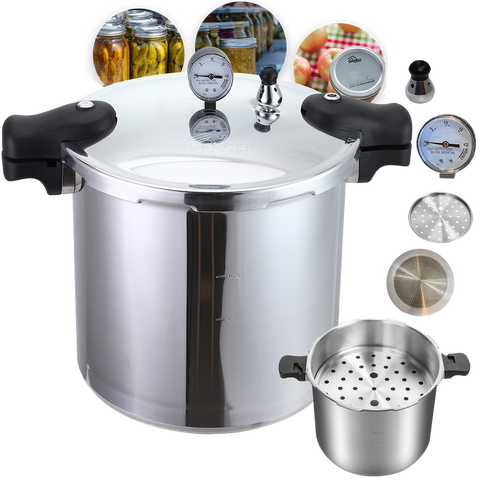
A 23-quart canner Tanker can sit flat on a low shelf, in a deep bottom cabinet, or even in a labeled storage area outside the kitchen if cabinet space is limited.
What matters is that it lives in the same place every time, so you're not hunting for it when a batch of tomatoes is already simmering.
Keep the compatible rack, weights, and other canner-specific accessories together whenever possible. That keeps small parts from spreading through several drawers and makes setup easier when canning season returns.
Explore THE TANKER™ Pressure Canner
See Denali's pressure canner and build a more organized preservation setup around one dedicated piece of equipment.
View THE TANKER™ →Multiply Shelf Space With the Right Racks
Vertical space gets wasted more than almost any other part of a small kitchen, and canning supplies are an easy category to improve.
A set of stackable canning racks is useful during processing and can be stored directly with the canner when not in use.
Inside cabinets, shelf risers and dividers can create additional usable levels without forcing you to stack fragile glass directly on top of other jars.
Tension rods can help keep flat organizers upright instead of letting them disappear underneath other supplies.
If your cabinets are shallow, look at the back of cabinet doors too. Lightweight organizers can hold funnels, jar lifters, measuring tools, and other small accessories that would otherwise take up valuable drawer space.
Stock Smart So You're Not Storing Extras You Don't Need
One of the quietest space-savers in small kitchen storage is simply buying less at once.
It sounds counterintuitive when canning season tempts you to stock up, but a cabinet full of half-used boxes of mismatched lids takes up more room than a smaller, predictable inventory.
Denali's canning bundles can make restocking easier when you want compatible supplies grouped together.
Before buying more, do a quick inventory of what's already in the cabinet. It's easy to order a fresh set of lids and forget that another package is tucked behind something else.
A five-minute check before restocking prevents duplicate supplies from slowly eating up your shelf space.
Explore Denali Canning Bundles
Shop grouped canning supplies when you want a simpler way to replenish the essentials your preservation routine actually uses.
Browse Canning Bundles →Keep Your Canning Supplies Storage Simple to Maintain
The best canning supplies storage setup is the one you'll actually keep up with after the first few weeks of enthusiasm wear off.
Overly complicated labeling systems or specialty containers tend to make maintenance harder than it needs to be.
Stick with clear bins, simple labels, and a layout that puts the most-used items at eye level and the rarely used extras higher or lower.
If you're new to the process or resetting your storage from scratch, revisit a solid pressure canning guide so you know exactly which supplies you need on hand and which ones you can skip.
Knowing what you actually use narrows down what you need to store in the first place, which is really the whole point.
Small kitchen storage for canning supplies isn't about cramming more in. It's about knowing what you use, giving it a consistent spot, and letting go of the extras that take up space without earning their keep.
Once jars, lids, rings, and your canner each have a real home, canning season stops feeling like a wrestling match with your cabinets and starts feeling like part of the routine it's supposed to be.
Start with one shelf this week, and let the rest of the system follow from there.
Explore Denali Canning
Browse pressure canners, lids, rings, racks, and preservation supplies designed to support your next canning season.
Visit Denali Canning →




Comments (0)
There are no comments for this article. Be the first one to leave a message!