
The table is cleared, the guests are gone, and half a bird is still sitting in the fridge. You can eat turkey sandwiches for a week, or you can turn that meat into shelf-stable jars you will be glad to open in February. Canning turkey is one of the most practical things a home canner can do after a holiday meal, and it follows the same tested process as other poultry. Here is how to do it safely, step by step, with the times and pressures that actually matter.
Can you safely can leftover turkey at home?
Yes. Turkey is a low-acid food, so it must be pressure canned, never water bath canned. Extension guidance applies the USDA poultry process to turkey: boneless pints for 75 minutes and quarts for 90 minutes, with pressure set by your canner type and elevation.
The reason is simple. Low-acid foods can carry Clostridium botulinum spores, and only the higher temperature inside a pressure canner destroys them. Boiling water never gets hot enough, no matter how long you leave the jars in.
Leftovers need a little extra care. Use turkey that was refrigerated promptly after the meal, and do the canning within a day or two. Strip the meat from the bones and cut away excess fat and skin. If the bird was stuffed, make sure no stuffing or dressing ends up in your jars or broth. Bread and starch change how heat moves through the jar, and the tested times do not account for them.
If you are new to pressure canning, read through our pressure canner safety checks before every batch first. Five minutes of checking saves a ruined batch.
What do you need for pressure canning turkey?
You need a pressure canner, clean Mason jars, new flat lids, rings, a jar lifter, and hot broth or water. Most of the work is prep. The canner does the safety work, as long as you follow the tested time and pressure for your altitude.
Here is the short list:
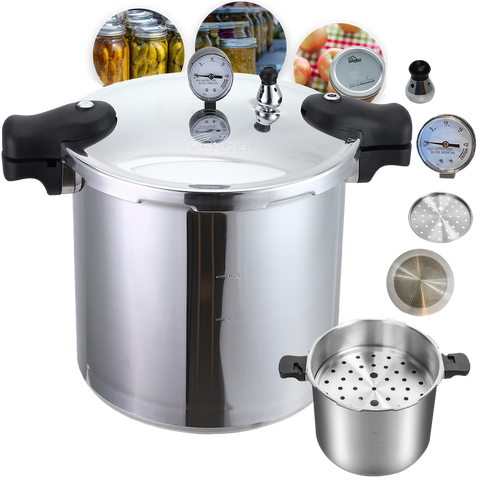
- A pressure canner with a rack. The Tanker™ 23 quart pressure canner ships with a 10 pound pressure regulator, a pressure gauge, and a canning rack, and its base works on all stovetops, including induction.
- Pint or quart jars with no chips or cracks along the rim.
- New flat lids every time. Rings can be reused if they are not bent or rusted. Stock up on Denali canning lids before the holiday rush so you are not hunting for them the day after.
- Hot turkey broth (strained) or boiling water, salt if you like it, a headspace tool, and clean towels.
Pressure canning turkey goes faster when everything is laid out before you start cutting meat.
How do you can turkey step by step?
Debone the turkey, pack it hot or raw with 1 1/4 inch headspace, add lids and rings, then process at the right pressure. Vent the canner for 10 minutes before you build pressure, and start timing only once you reach the target pressure.
- Prep the meat. Remove bones, skin, and excess fat. Cut the meat into pieces that fit your jars.
- Choose your pack. For a hot pack, heat the meat in broth until about two-thirds done, then fill jars with the pieces and hot broth. For a raw pack, fill jars loosely with raw meat and add no liquid. Hot pack is preferred for better liquid cover and quality in storage. Cooked leftover turkey is already past raw, so most people hot pack it in strained broth.
- Leave 1 1/4 inch headspace. Add 1 teaspoon of salt per quart if you want it. Remove air bubbles and wipe the rims clean.
- Lid and load. Center new lids, screw rings on fingertip tight, and set jars on the rack with a few inches of hot water in the canner. Our guide on how to stack jars in The Tanker walks through loading a full batch.
- Vent, then pressurize. Let steam flow steadily from the vent for 10 minutes, then add the weight.
- Process. Boneless pints run 75 minutes. Boneless quarts run 90 minutes. If pressure drops below your target, bring it back up and restart the timer from zero.
- Cool naturally. Turn off the heat and let the canner drop to zero pressure on its own. Wait 10 more minutes before opening the lid away from your face.
What pressure should you use for canning turkey?
Use 10 pounds in a weighted gauge canner at 0 to 1,000 feet, or 15 pounds above 1,000 feet. In a dial gauge canner, use 11 pounds at 0 to 2,000 feet and add one pound for each extra 2,000 feet of elevation.
Here is the quick reference for boneless turkey, from USDA and National Center for Home Food Preservation poultry guidance:
| Canner type | Elevation | Pressure | Pints | Quarts |
|---|---|---|---|---|
| Weighted gauge | 0 to 1,000 ft | 10 lb | 75 min | 90 min |
| Weighted gauge | Above 1,000 ft | 15 lb | 75 min | 90 min |
| Dial gauge | 0 to 2,000 ft | 11 lb | 75 min | 90 min |
| Dial gauge | 2,001 to 4,000 ft | 12 lb | 75 min | 90 min |
If you are not sure of your elevation, look it up before canning day. Getting this wrong is the most common mistake with meat. If you live above 1,000 feet, our tutorial on setting up and understanding The Tanker's weights shows how the weights work.
How do you store and use canned turkey?
Check every seal after 12 to 24 hours, remove the rings, label the jars with the date, and store them somewhere cool, dark, and dry. For best quality, use canned turkey within about a year, and toss any jar that has lost its seal.
A sealed lid is curved down in the center and does not flex when you press it. Any jar that did not seal goes in the fridge to eat within a few days, or gets reprocessed with a new lid within 24 hours.
Once your shelf is stocked, canned turkey becomes the shortcut you will reach for again and again. Drain a pint into turkey pot pie, toss it into soup or chili, mix it into enchiladas, or fold it into a quick turkey salad. It is fully cooked and tender, so weeknight dinners take minutes instead of an hour.
Ready for your next batch?
That half-eaten bird does not have to become a week of tired sandwiches. With a reliable canner, fresh lids, and the right time and pressure, it becomes a row of jars you will be proud to pull from the pantry. Get your canner ready before the holiday, and if you want to learn alongside other canners, the Classroom community is a good place to ask questions.
Watch the full walkthrough below:
FAQs
1. Can you water bath can turkey? No. Turkey is a low-acid food and must be pressure canned. A water bath never reaches the temperature needed to destroy botulism spores, even with a long processing time.
2. How long do you pressure can turkey? Process boneless turkey for 75 minutes in pints and 90 minutes in quarts. Turkey canned with bones runs 65 minutes for pints and 75 minutes for quarts. Always use the pressure for your canner type and elevation.
3. Can you can turkey that was already cooked? Yes. Cooked leftover turkey can be canned using the hot pack method with the same times as boneless poultry. Use meat that was refrigerated promptly, remove all bones, skin, and stuffing, and pack it in hot strained broth or water.
4. Can you can turkey with stuffing or gravy? No. Stuffing, flour, and thickened gravy are not part of a tested process and can keep heat from reaching the center of the jar. Can the plain meat and broth, then add stuffing or make gravy when you serve it.
5. Should I can turkey broth and meat together? You can pack meat in hot broth for a hot pack. If you want plain broth on the shelf too, can it separately. Strained broth on its own has a much shorter process time than meat.
6. How long does canned turkey last? For best quality, use it within about a year. Store sealed jars in a cool, dark, dry place without the rings. Never eat from a jar with a bulging lid, a broken seal, or an off smell.


Comments (0)
There are no comments for this article. Be the first one to leave a message!