
Not every pressure canner works on every stove, and finding that out mid-batch is one of the more frustrating ways to lose an afternoon. Glass-top ranges, induction burners, and old-school gas stoves each put different demands on cookware, and a pressure canner that's perfect for one setup can be a poor match, or even a safety risk, on another. Before you buy, it's worth understanding what your stove type actually needs from a canner, since the wrong pairing can mean uneven heating, a canner that never quite comes up to pressure, or damage to an expensive glass cooktop. Here's how to match a pressure canner to the stove you actually have.
Why Stove Type Changes What Pressure Canner You Need
A pressure canner is a heavy, flat-bottomed pot that needs to sit directly on a heat source and hold a steady, even temperature for long stretches, sometimes ninety minutes or more depending on what you're processing. Gas stoves are fairly forgiving since the flame wraps around the base and heats evenly no matter what the pot is made of. Electric coil stoves are a bit pickier about full, flat contact with the burner. Glass-top and induction ranges are the strictest of all. Glass-tops need a base that won't scratch the surface and that distributes heat evenly enough to avoid hot spots that can crack the glass over time. Induction ranges only work with cookware that contains enough ferrous metal to respond to the magnetic field, so a canner built from the wrong material simply won't heat up at all, no matter how high you turn the dial. A simple magnet test on the base of any canner you're considering will tell you in seconds whether it's a fit for induction, and it's a quick check that can save you from an expensive return.
Matching a Pressure Canner to a Gas Stove
If you're cooking on gas, you have the most flexibility of any stove type, and that's good news if you're shopping on a budget or looking at older, secondhand canner designs. Gas burners heat the base of the pot directly and evenly, so material and base thickness matter less here than they do on other stovetops. That said, a canner still needs to sit flat and stable, so check that the base isn't warped, especially if you're inheriting an older unit from a relative or picking one up secondhand. A wobbly canner full of hot jars is a real hazard, and it's one of the more common reasons people underestimate how much a stable base matters even on the most forgiving stove type. If your gas burner runs on the smaller side, look at the canner's total base diameter too, since a canner that overhangs the burner significantly will heat unevenly no matter how good the flame is. Ventilation is worth thinking about as well, since gas kitchens often run hotter and more humid during a long processing session than electric kitchens do, so cracking a window or running a range hood on high can make the whole process more comfortable, especially in the middle of summer canning season.
Choosing a Pressure Canner for Electric Coil Stoves
Electric coil stoves need a bit more attention to the base of the canner than gas does. Coils heat up more slowly and hold residual heat longer, which means you need a flat, heavy base that makes full contact with the coil to avoid hot spots and long temperature swings. A thin or slightly warped base will heat unevenly here in a way it might not on gas, so this is one stove type where checking the flatness of the canner before you buy actually matters. Coil stoves also tend to run a bit hotter than the dial suggests once they're fully heated, so budget extra time when you're bringing a canner up to pressure for the first time on a new unit, and don't assume the manufacturer's estimated heat-up time will match yours exactly. It's also worth checking the coil size against the canner's base before your first batch. A canner set on a coil that's noticeably smaller than its own diameter will heat unevenly around the edges, and that unevenness can make it harder to hold a steady pressure reading over a long processing time.
Picking a Pressure Canner for Glass-Top and Induction Ranges
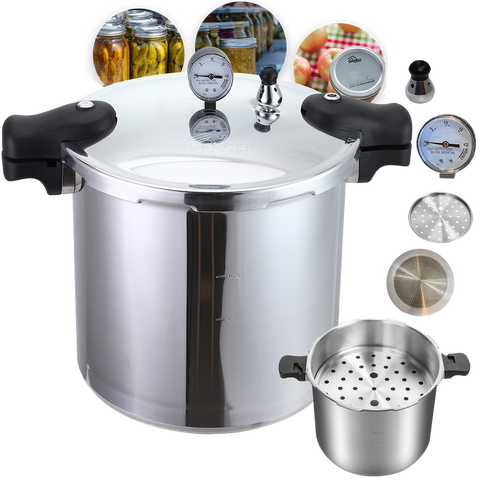
This is where stove type really starts to narrow your options. Glass-top ranges need cookware with a smooth, flat base and no sharp edges or texture that could scratch the surface over repeated use, and a heavier base helps distribute heat evenly enough to avoid the hot spots that stress glass cooktops over time. Induction is stricter still, since the range relies on a magnetic field to generate heat directly in the cookware itself. If the base isn't made from the right material, the burner won't recognize the pot at all, and you'll end up with a canner that sits there doing nothing no matter how high the setting goes. The tanker pressure canner is built with an induction-ready base specifically to solve this, so it's worth confirming compatibility like that in the specs before you buy if induction or glass-top is your setup at home. Skipping this check is the single most common reason people end up with a canner that technically works everywhere except the one stove they actually own.
What to Look for Beyond the Base Material
Once you've confirmed the base works with your stove, a few other details are worth checking before you commit. Capacity matters more than people expect. A 23-quart canner holds significantly more per batch than a smaller unit, which cuts down on how many rounds you need to run through a big harvest. Look at what comes included, too, since a dial gauge, a weighted valve system, and a canning rack are all things you'd otherwise have to buy separately. Denali Canning includes a dual weight system with most of its canners so you can process at different pressures depending on your altitude and what you're canning, which is a detail worth checking on any canner regardless of brand. Weight and handle design matter too, especially if you're canning solo and need to lift a full pot on and off the burner without help.
Keeping Your Pressure Canner Running Well on Any Stove
Once you've matched a pressure canner to your stove, a little maintenance keeps it performing the same way years down the line no matter what surface it's sitting on. Check the gasket before every season, since a worn seal is one of the most common reasons a canner struggles to hold pressure even when the stove itself is doing its job correctly. A replacement gasket is a cheap fix compared to replacing the whole unit, and it's worth keeping a spare on hand if you can regularly. The same goes for your pressure weight, since a weight that's rocking unevenly on the vent pipe instead of jiggling the way it should is often a sign it needs cleaning or replacing. Wipe down the base after every use too, particularly on glass-top ranges, since any residue left behind can bake onto the surface the next time the burner heats up.
Getting the Sizing Right for Your Kitchen
Stove compatibility is only half the equation. The canner also has to physically fit your setup and your storage space. Measure your largest burner and compare it to the canner's base diameter before you order, since a mismatch in either direction, a canner too small for a large burner or too large for a small one, leads to uneven heating regardless of stove type. Think about counter and cabinet space too. A 23-quart unit is a serious piece of cookware, and it needs a dedicated spot to live when it's not in use. If you're tight on storage, look at whether the TANKER canner can nest with your other cookware or if it needs its own shelf entirely, since that's an easy detail to overlook until the canner actually shows up at your door. It's also worth thinking about how many people you're canning for and how often. Someone putting up a few jars of jam a couple times a year has very different needs than someone processing a full garden harvest every week for a month straight, and that difference should influence both the size you buy and how much you're willing to spend on a unit built for frequent, heavy use.
Matching your pressure canner to your stove type isn't just about performance, it's about safety and getting consistent results batch after batch. Take a few minutes to confirm base material, size, and included accessories before you buy, and you'll spend a lot less time troubleshooting once you're actually canning.

Frequently Asked Questions
Can I use any pressure canner on a glass-top stove?
Not safely. Glass-top ranges need a canner with a flat, smooth base and enough weight to distribute heat evenly, since a warped or uneven base can create hot spots that stress the glass over time. Always check the manufacturer's specs for glass-top compatibility before buying.
Will a pressure canner work on an induction cooktop?
Only if the base contains enough ferrous metal to respond to the induction burner's magnetic field. A simple magnet test on the canner's base will tell you quickly whether it's compatible. Canners built specifically for induction, like Denali's TANKER, are designed with this in mind.
Do I need a different pressure canner for gas versus electric stoves?
Not necessarily. Gas is the most forgiving stove type, and most canners built for electric coil stoves will work fine on gas too. The reverse isn't always true, since a canner built loosely for gas may not have the flat, heavy base that electric coils need for even heating.
How big of a pressure canner do I actually need?
That depends on how much you're processing at once and how often you can. A 23-quart canner suits anyone putting up large batches or a full harvest, while occasional canners doing smaller runs may be fine with a more compact size. Think about storage space too, since larger units need a dedicated spot in your kitchen.
What accessories come with most pressure canners?
Most include a dial gauge, a weighted valve or weight set, and at least one canning rack for holding jars off the bottom of the pot. Some, like Denali's canners, include a dual weight system for processing at different pressures. Always check what's included before assuming you'll need to buy accessories separately.
How do I know if my pressure canner's gasket needs replacing?
If your canner is struggling to build or hold pressure even though everything else checks out, a worn gasket is often the cause. Look for cracking, flattening, or a gasket that no longer sits snugly in its groove. Replacing it is inexpensive and usually solves the problem right away.




Comments (0)
There are no comments for this article. Be the first one to leave a message!