
Walk into any homesteading forum or canning group and you will find the same question asked over and over: Which pressure canner should I buy? It is a fair question ,and an important one. Your pressure canner is the single most critical piece of equipment in your home preservation setup. Buy the wrong one and you will be dealing with seal failures, stovetop incompatibility, and confusing gauges. Buy the right one and you will be filling your pantry with confidence for years to come.
This guide covers everything you need: size, gauge type, material, stove compatibility, safety features, and the canning supplies that complete your setup. By the end, you will know exactly what to look for and feel confident making your purchase.
Why Your Pressure Canner Choice Matters
Pressure canning is not the same as cooking. When you use a pressure canner for canning, you are relying on that equipment to reach and maintain 240 degrees Fahrenheit ,the temperature needed to destroy dangerous bacteria, including Clostridium botulinum, which causes botulism. This is not a situation where close enough is acceptable.
A low-quality or mismatched canner can result in inaccurate pressure readings, seal failures, stove incompatibility, and wasted food. Investing in a well-built pressure canner from the start protects your food, your family, and your time.
Size and Capacity
Pressure canners are measured in quarts and typically range from 16 quarts up to 41 quarts. For most families, the 23-quart pressure canner is the sweet spot. It holds up to 7 quart jars or 18 to 19 pint jars in a single batch ,large enough to be worth your time, yet manageable on a standard home stove.
Smaller 16-quart pressure canners work for one or two people or small test batches, but most canners outgrow them quickly. Larger 30 to 41-quart models are excellent for homesteads processing hundreds of jars per season, but they are heavy and can be overkill for most beginners. Start with 23 quarts unless you have a specific reason to go larger or smaller.
Gauge Type: Dial, Weighted, or Both
The gauge type is one of the most important decisions when choosing a pressure canner, and also one of the most misunderstood.
Dial Gauge Canners
A dial gauge gives you a visual readout of the exact pressure in PSI. It sounds ideal, but it requires annual calibration by your local cooperative extension office, and demands constant monitoring throughout processing. An inaccurate or unwatched dial gauge is a real food safety risk.
Weighted Gauge Canners
A weighted gauge ,also called a jiggler ,sits on the vent pipe and automatically releases steam when the canner reaches the correct pressure. No calibration required, no constant watching. When you hear it rocking, you know you are at the right pressure. It is simpler and more beginner-friendly, though it only offers 5 and 10 PSI settings.
Dual System: The Best of Both
The best pressure canners include both a dial gauge and a weighted regulator. The dial gives you visual feedback while the weighted system handles self-regulation and accuracy. This combination removes guesswork and is especially valuable for beginners. Always prioritize a canner that includes both.
Material: Aluminum vs. Steel Core
Aluminum has been the traditional material for pressure canners for decades. It is lightweight, heats quickly, and is generally affordable. However, aluminum is not compatible with induction stovetops because it is not magnetic. If you have or plan to upgrade to an induction stove, an aluminum canner simply will not work.
Steel-core pressure canners work on all stove types ,gas, electric, glass-top, and induction ,without exception. They are also more durable and warp-resistant over time. Even if you do not currently have an induction stove, choosing a steel-core canner future-proofs your investment.
Safety Features to Look For
Home canning involves sustained high pressure and heat. The safety features built into your pressure canner matter. Every canner should include at least one overpressure plug that releases steam before anything dangerous occurs. Better models include two safety vents for redundant protection, plus locking handles that keep the lid securely in place during processing.
Some modern pressure canners also feature a self-venting design that automatically vents steam during initial heating, eliminating the need to manually time a 10-minute venting period. This saves time every batch and reduces one more step for beginners. Always verify the canner you choose is designed to meet USDA guidelines for safe home food preservation.
Canning Supplies to Complete Your Setup
Your pressure canner is the heart of your setup, but the right canning supplies and canning products make every session smoother and safer. Here is what you need alongside your canner.
Mason jars in regular and wide mouth styles are the standard for home canning. Quart and pint sizes are the most versatile. Always use new canning lids for every batch ,they are designed for single use, and reusing them is one of the most common causes of seal failure. Rings can be reused as long as they are rust-free and in good condition.
Other essential canning products include a jar lifter for safely removing hot jars, a canning funnel for clean filling, a bubble remover and headspace tool for accurate jar prep, a reliable kitchen timer, and heat-resistant oven mitts. These are not optional extras ,they are the tools that make pressure canning safe and repeatable every time.
Price vs. Value
Pressure canners range from around 80 dollars on the low end to 300 dollars or more for professional-grade models. Budget canners often use basic aluminum construction, a single dial gauge, and minimal safety features. They can work for occasional use but lack the durability and precision of better-built options.
Mid-range pressure canners in the 130 to 180 dollar range represent the best value for most home canners. In this range you will find steel-core construction, dual gauge systems, multiple safety vents, and solid build quality that will last for decades. A canner that keeps your food safe and lasts 20 years is far better value than a cheap one you replace every few seasons.
The Denali TANKER: Built for Every Canner
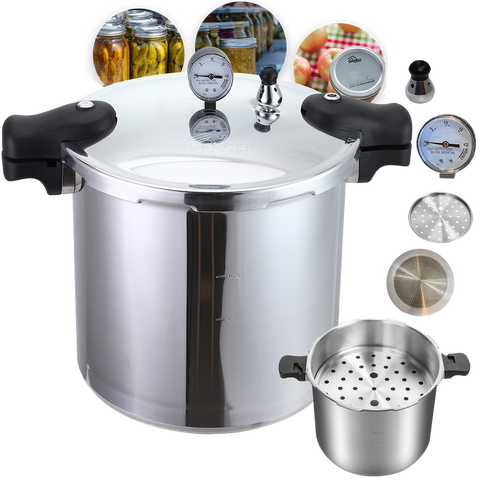
If you want a pressure canner for canning that checks every box on this list, the Denali Canning TANKER 23 Quart Pressure Canner was designed exactly with that goal in mind. It features a dual dial-and-weight pressure system, two safety vents, locking handles, a steel-core base for full induction and glass-top compatibility, and a self-venting design that saves you 10 or more minutes per batch.
Every TANKER comes with a free beginner canning course, access to a private community of thousands of canners, packs of wide and regular mouth lids, and lifetime customer support. It is the number one rated beginner-friendly pressure canner trusted by over 125,000 canners across the USA and Canada, backed by a 90-day no-risk guarantee.
Buy Smart, Can Confidently
Choosing the right pressure canner is the foundation of everything else in home food preservation. Get it right and you will have a tool that serves your family for decades, helps you build a meaningful food supply, and makes every canning session something to look forward to.
To summarize: choose a 23-quart pressure canner for the best balance of capacity and manageability. Look for a dual dial and weighted gauge system. Make sure it has a steel-core base for full stove compatibility. Verify it includes multiple safety vents and locking handles. Complete your setup with quality canning supplies. And do not sacrifice safety for price ,a reliable pressure canner for canning is a long-term investment that pays for itself every season.




Comments (0)
There are no comments for this article. Be the first one to leave a message!